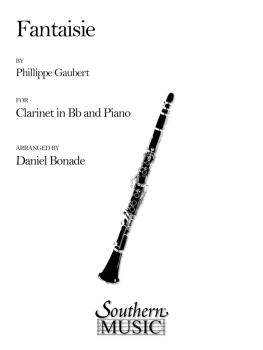

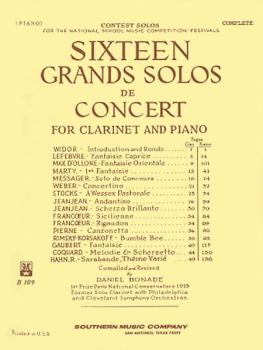
Former Clarinet soloist with both the Philadelphia and Cleveland Orchestras, Daniel Bonade, compiled this repertoire rich collection that incorporates many of the most performed solo repertoire for the clarinet.
MORE»
| List | $45.00 |
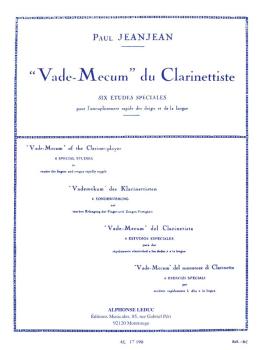
Vade-Mecum for the Clarinet is a set of six studies by Paul Jeanjean (1874-1928) and was composed for intermediate level players who don't always have the time to practise but have to be warmed up. It should prepare them in approximately half an hour and is particularly good to render the fingers and tongue rapidly supple. It should also help to overcome imperfections and weaknesses. Paul Jeanjean (1874-1928) is a French composer known for his clarinet compositions. He also composed 16 Études modernes, Arabesques and Clair Matin.
MORE»
| List | $19.99 |
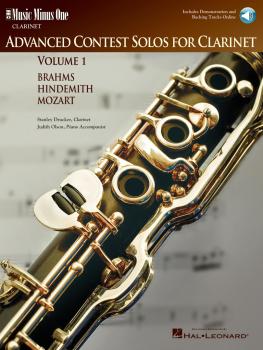
Performed by Stanley Drucker, clarinet
Accompaniment: Judith Olson, piano
Advancing clarinetists will love this challenging collection drawn from widely used State Contest Pieces, including great repertoire from Classical (Mozart), Romantic (Brahms), and Modern (Hindemith) eras. The scores are annotated by the soloist on this album, Stanley Drucker of the New York Philharmonic. Includes a high-quality printed music score annotated with performance suggestions and top-notch audio files with complete versions (with soloist) followed by piano accompaniments to each piece, minus the soloist. The audio is accessed online using the unique code inside each book and can be streamed or downloaded. The audio files include PLAYBACK+, a multi-functional audio player that allows you to slow down audio without changing pitch, set loop points, change keys, and pan left or right.
MORE»
| List | $18.99 |

Born in Prague in 1901, Hans, or rather Hanus Winterberg, had found his style around the mid-1930s, to which he would remain faithful until the end of his life, representing a unique but not untypical symbiosis of different influences for Czech modernism: the Second Viennese School, mediated by his teacher Alexander Zemlinsky, French Impressionism and, becoming more and more prominent over time, the folk-inspired, rhythmically dominated music of Leos Janácek. Winterberg did not have much time to build a career, because from March 1939 at the latest, after the annexation of the so-called “Resttschechechei” by Nazi Germany, he, as a Jew, was forbidden any professional activity. Exploited as a forced laborer from 1941, he probably only escaped deportation to Theresienstadt and death in Auschwitz through the protection of his marriage to the respected Sudeten German pianist Maria Maschat. The handwriting of the few compositions written during the war bears witness to the existential hardship in which they were written, but also to the immense spiritual resistance of their creator. The Suite for clarinet and piano from 1944, published here for the first time, is not only a substantial contribution to the clarinet literature, but also a unique document of artistic self-assertion.
MORE»
| List | $40.00 |
Written for upper-intermediate to advanced clarinet players, these scales and exercises are a set of studies tailored for advanced courses. Composed by Gaston Hamelin, this piece includes a really explanatory preface that describes the positioning and the annotations that are crucial to an understanding of the book. Ideal to continue developing skills and technique, they focus on mastering scales arpeggios and trills to obtain a fluidity of the tone. Gaston Hamelin (1884-1951) was a French carinettist and teacher. He became the first clarinettist of the Boston Symphony Orchestra and went back to France in the 1930s to teach his instrument.
MORE»
| List | $26.00 |